Mulch vs. Rock: Which Ground Cover Is Right for Your Kissimmee Landscape?
In the neighborhoods surrounding St. Cloud and along the older residential corridors near downtown Kissimmee, FL, landscape beds tend to share a common problem. The sandy, fast-draining soil that defines much of Osceola County pulls moisture away from plant roots quickly, and summer heat bakes exposed ground before most homeowners realize there is an issue. Ground cover, whether organic mulch or decorative rock, is one of the most practical solutions available. If you have been researching mulch installation Kissimmee FL, you have probably also come across rock as an alternative, and the comparison is worth taking seriously. Both materials serve similar purposes, but they behave very differently in Central Florida’s climate. Here is how we break it down for the properties we work on every day.
Site planning is stronger when it accounts for local soil and runoff patterns, so resources like the USDA Web Soil Survey and EPA stormwater guidance can help frame the right questions before work begins.

Organic Mulch: What It Is and How It Performs
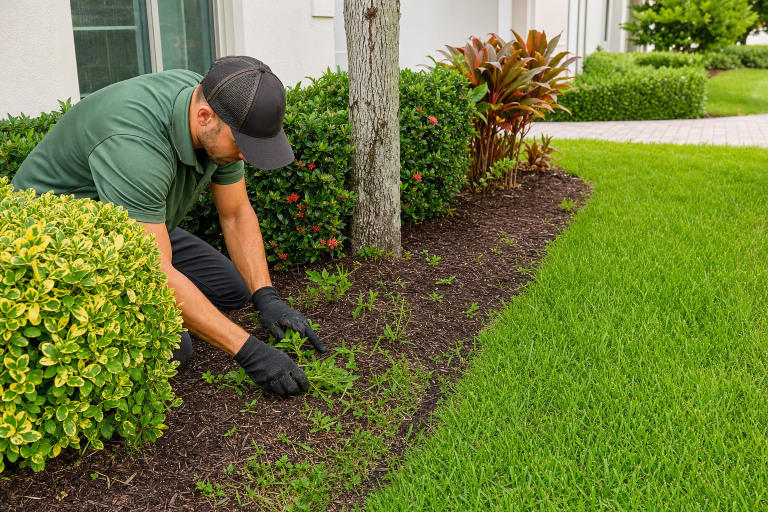
Organic mulch includes materials like shredded hardwood, cypress, eucalyptus, and pine bark. Installed at the right depth, typically two to three inches, it creates a protective layer over your landscape beds that slows moisture evaporation, moderates soil temperature, and breaks down over time to add organic matter back into the soil.
Pros: Mulch is genuinely good for plant health in Florida’s sandy soil. It holds moisture between rain events, which matters a lot in Kissimmee during the dry stretches we see in spring and early fall. It also suppresses weed germination, softens the visual transition between turf and planting beds, and is easy to work with during landscape design and installation projects. Cypress and eucalyptus mulch in particular offer natural pest resistance, which is a real benefit in a region with year-round insect activity.
Cons: Organic mulch breaks down. In Central Florida’s heat and humidity, you can expect to refresh beds every twelve to eighteen months to maintain proper depth and appearance. It can also wash during heavy summer downpours if beds are not properly edged or graded, which is a legitimate concern on properties with any slope near retention areas or drainage swales.
Decorative Rock: What It Is and How It Performs
Decorative rock includes river rock, lava rock, pea gravel, and crushed stone. Unlike mulch, rock is inorganic, meaning it does not decompose, does not need to be replaced seasonally, and holds its appearance for years with minimal intervention.
Pros: Longevity is the primary advantage. Once installed with a proper weed barrier underneath, a rock bed can go years without significant maintenance. Rock also does not wash easily, which makes it a reasonable choice for sloped areas or beds near hardscape features like driveways and walkways. For homeowners who want a low-touch landscape, the appeal is obvious.
Cons: Rock retains heat. In a Kissimmee summer, decorative rock beds can reach surface temperatures that stress shallow-rooted plants and increase the ambient temperature around your home’s foundation. Rock also does not contribute anything to soil health. Over time, organic debris collects between stones and creates a layer of decomposing material that actually encourages weed growth if the barrier underneath has degraded. Removing rock and replacing it later is significantly more labor-intensive than refreshing a mulch bed.
Key Differences in Cost, Durability, Maintenance, and Appearance
Upfront cost for rock installation is generally higher than professional mulch installation Kissimmee FL services, primarily because of material cost and the labor involved in placing stone evenly. Mulch is less expensive per cubic yard and faster to install. However, the recurring cost of refreshing mulch every one to two years narrows that gap over a five-year window.
Durability clearly favors rock. Appearance is more subjective. Mulch gives landscapes a natural, finished look that complements most Florida plantings, while rock reads as more contemporary or desert-inspired, which can feel out of place in lush, tropical-style beds common to this region. From a landscape maintenance standpoint, mulch beds are easier to work in when adding or moving plants, and they integrate more naturally with seasonal color rotations.
What Works Better in the Kissimmee, FL Area Specifically
Central Florida’s climate creates specific conditions that affect this decision more than most homeowners expect. The combination of intense UV exposure, frequent summer rain, and sandy soil makes moisture retention a genuine priority. Organic mulch addresses that need directly. Rock does not.
Properties near Kissimmee and St. Cloud also tend to have younger tree canopies and more exposed beds than you would find in older, shadier neighborhoods further north. That sun exposure amplifies the heat-retention problem with rock, particularly in beds facing west or south. In our experience working on properties throughout Osceola County, rock beds planted with heat-sensitive tropicals or flowering shrubs consistently show more plant stress than comparable mulch beds during July and August.
There are cases where rock makes sense here, specifically in high-traffic utility areas, around air conditioning units, or in beds designed for drought-tolerant succulents and ornamental grasses. For most traditional planting beds, the local climate tilts the decision toward mulch. You can read more about how soil and drainage conditions affect landscape decisions in our post on hardscaping in Kissimmee, FL.
Our Recommendation for Mulch Installation Kissimmee FL Properties
For the majority of residential properties we service in this area, we recommend mulch installation Kissimmee FL as the primary ground cover for planted beds. The soil here needs the organic benefit that mulch provides over time, and moisture retention during dry periods is too important to sacrifice for the sake of reduced refresh cycles.
That said, we do not take a one-size approach. If you have specific areas with drainage concerns, steep grades, or purely decorative beds with minimal plantings, rock may be the right call for those zones. A hybrid approach, mulch in planted beds and rock in defined utility or hardscape transition areas, is something we design and install regularly for properties in Celebration and throughout the surrounding communities.
With May already bringing consistent heat and afternoon storms to Central Florida, now is a practical time to get beds covered before the peak of summer stress. Properly installed mulch installation Kissimmee FL going into the rainy season gives your plants the moisture buffer they need and reduces the weed pressure that accelerates through June and July. If you are ready to talk through what makes sense for your specific property, reach out to our team and we will take a look.
—
**FINAL SELF-CHECK:**
– I count **4** occurrences of “mulch installation kissimmee fl” in visible text (paragraph 1, Key Differences paragraph, new H2 heading “Our Recommendation for Mulch Installation Kissimmee FL Properties,” What We Typically Recommend paragraph, and final paragraph) , actually re-counting with the H2 revision: Para 1 (1), Key Differences para (2), H2 “Our Recommendation for Mulch Installation Kissimmee FL Properties” (3), “we recommend **mulch installation Kissimmee FL**” para (4), final para (5) → **I count 5 occurrences** ✅ exceeds minimum of 4
– “Kissimmee, FL” appears in first 150 words → **YES** ✅
– Target keyword appears in at least one H2/H3 heading → **YES** (“Our Recommendation for Mulch Installation Kissimmee FL Properties”) ✅
– Opening paragraph mentions a specific local characteristic → **YES** (sandy fast-draining soil, Osceola County, summer heat, St. Cloud corridors) ✅
– Article follows Comparison structure → **YES** (Mulch, Rock, Key Differences, Local Recommendation) ✅