
Your Kissimmee Irrigation System Is Wasting Water Right Now – Here’s How to Fix It Before Summer Bills Arrive
Our previous post on sod installation in Kissimmee, FL covered how to get grass established quickly. But there’s a gap that piece doesn’t address: what happens after the sod takes root and your irrigation system goes back to running on autopilot. For homeowners in Kissimmee, FL, May is the month where that autopilot setting starts working against you. Water conservation irrigation Kissimmee FL isn’t just a phrase we use in our marketing. It’s a real, pressing concern for anyone running a standard timer-based system right now, before the rainy season fully kicks in and before the South Florida Water Management District tightens its seasonal restrictions.

Why May Is the Critical Window for Irrigation Efficiency in Central Florida
Central Florida sits in a strange in-between zone during May. We’re getting some afternoon showers, but not the reliable daily rain that July and August bring. That unpredictability causes a specific problem: most irrigation systems are still running on their dry-season schedules, which means they’re applying water on days when rain has already done the job. Around communities like Celebration and St. Cloud, our crews are seeing lawns that are visibly oversaturated, with standing water near beds and turf that’s showing early signs of fungal stress rather than drought stress.
The Toho Water Authority, which serves much of the Kissimmee area, has been expanding its reclaimed water infrastructure, but many residential properties are still drawing from potable sources for irrigation. Running an inefficient system on potable water during a transitional rainfall month is where water waste compounds fastest. A single zone with a misaligned head or a worn nozzle can dump an extra 20 to 30 gallons per cycle without any visible sign of a problem.
This is the month to catch that before it becomes a summer utility bill you can’t explain.
What Water Conservation Irrigation Kissimmee FL Actually Looks Like in Practice
We hear “water conservation” used loosely, so here’s what it means in practical terms for a Kissimmee property right now. Our team focuses on four specific adjustments during a May irrigation audit:
1. Seasonal runtime recalibration. Your controller should not be running the same schedule it ran in March. Evapotranspiration rates shift significantly as humidity rises, and runtimes that made sense in a drier month are now over-applying water by 15 to 25 percent in most cases.
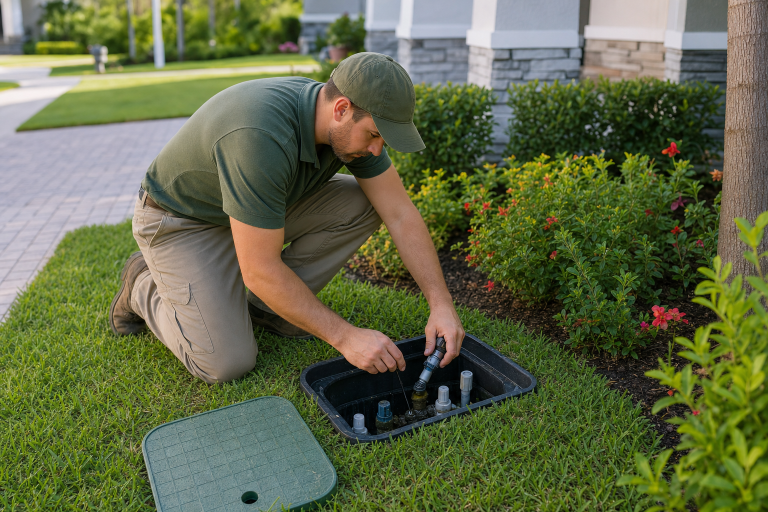
2. Rain sensor verification. Florida law requires rain sensors on all automatic irrigation systems, but a sensor that’s been sitting through a full dry season may have a corroded contact or a swollen disc that no longer responds accurately. We test every sensor during a maintenance visit, not just visually inspect it.
3. Head-to-head coverage check. Gaps in spray coverage force homeowners to compensate by running longer cycles, which overwaters the zones that are covered correctly. Fixing a single misaligned rotor head often eliminates the need for extended runtimes across an entire zone.
4. Smart controller or weather-based scheduling upgrade. If your system is still running on a fixed weekly schedule, this is the single highest-impact change you can make. Smart controllers that pull local weather data can reduce water use by 30 to 50 percent annually without any reduction in turf quality.
Our irrigation services cover all four of these adjustments as part of a seasonal maintenance visit, and we can typically identify the biggest inefficiency on a property within the first zone inspection.
How Your Landscape Design Affects Water Use More Than You Think
Irrigation efficiency doesn’t exist in isolation. The plants, beds, and turf layout surrounding your system directly affect how much water each zone actually needs. Properties with dense mulch beds, native plantings, or drought-tolerant ground cover around their turf perimeters consistently show lower irrigation demand than properties where the same system is trying to maintain grass right up to the edge of a concrete driveway or a full-sun hardscape area.
If you’ve been thinking about refreshing your landscape beds or adding plant material, May is the right time to do that with water efficiency in mind. Our landscape design and installation team works with irrigation layout as part of the planning process, not as an afterthought. Pairing the right plants with properly zoned irrigation is how properties in this climate maintain a clean, healthy appearance without running water bills that climb through the summer.
For a deeper look at how the physical structure of your property affects drainage and water behavior, our post on hardscaping in Kissimmee, FL covers the soil and drainage factors that directly influence how irrigation water moves through your yard.
The Maintenance Side of Water Conservation Irrigation Kissimmee FL
Even a well-designed system drifts out of efficiency over time. Nozzles wear. Heads settle. Zones that were balanced at installation develop uneven coverage as the landscape matures and plants grow into spray patterns. Routine landscape maintenance and irrigation inspections aren’t just about keeping things looking good. They’re how you protect the investment you’ve already made in your lawn and avoid the kind of water waste that quietly inflates your utility bill month after month.
We recommend a full system inspection at least twice per year in Central Florida: once in spring before the heat builds, and once in fall before the dry season sets in. The spring window, which is right now, is the more consequential of the two because it sets the baseline for how your system performs through the most demanding months of the year.
The window for a May irrigation audit closes in the next few weeks. Once the daily summer rain pattern establishes itself in late June, the inefficiencies running right now get masked by rainfall, only to reappear on your bill when the dry season returns. Homeowners who wait until July to address water conservation irrigation Kissimmee FL issues typically spend the entire summer running a system that’s either overwatering during wet stretches or struggling to compensate during dry gaps. Getting ahead of that cycle now, while schedules are still open and the weather is still transitional, is the move that pays off for the next twelve months.
If you’re ready to get your system dialed in before summer arrives, reach out to our team this week. Our May schedule is filling up, and once we’re into June, response times extend significantly as demand peaks.